Digitization in production: 5 insights from 5 years of practice at KOMOS
1st June 2026
What we really learned on our journey towards connected production
Digitalization, Industry 4.0, Artificial Intelligence – hardly any topic is shaping the industrial world more strongly at the moment. Yet amidst the many buzzwords and technologies, a crucial question arises for companies:
How does digitalization work in practice?
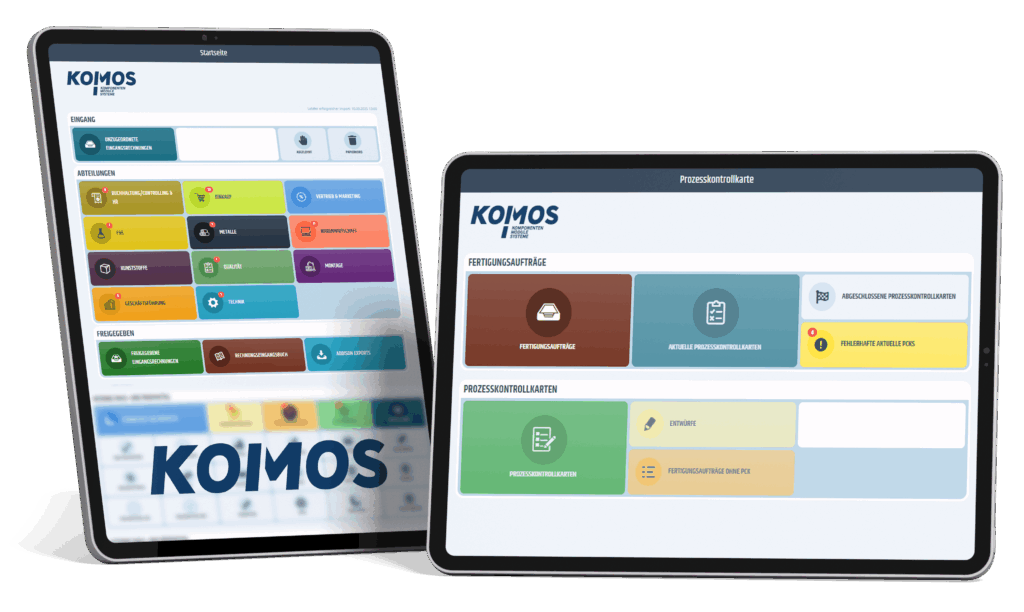
At KOMOS, we have been intensively working on digitizing our processes for several years. Today, we operate with our own KOMOS app, a connected MES system, digital dashboards, and largely paperless workflows. At the same time, we are continuously developing our capabilities for data utilization and decision support. In the process we learned:
Successful digitalization does not begin with technology; it begins with an understanding of processes, people, and relationships.
Five insights from our practice.
1. Digitization begins with processes – not with software
Most digitization projects start with the question:
„What software do we need?“
However, our experience shows that this is often the wrong first question. An inefficient process is not automatically made better by digital tools. It simply becomes more inefficient faster. That’s why at KOMOS, we first analyzed our processes before implementing new systems. In doing so, we identified information gaps, duplicate data collections, and unnecessary interfaces that often go unnoticed in day-to-day operations. Only when we understood and optimized these processes could digital solutions bring their true value to bear. Our most important finding:
Digitalization begins with transparency about existing processes – not with the selection of software.
2. Data creates transparency – integrated systems lead to better decisions
With increasing digitalization, the amount of available data also grows. Production data, quality metrics, delivery dates, inventories, or utilization rates are now available in almost every company. The real challenge, however, lies in making sense of this information. That is exactly why we searched for a technology partner for a long time who understands our philosophy of a completely integrated approach.
Our goal was never to introduce a separate solution. We wanted to create an environment in which information from ERP systems, production, the supply chain, and other data sources would be combined. Today, we use an AI-powered solution that significantly simplifies access to corporate knowledge. Employees can ask questions in natural language and directly access information from the connected systems.
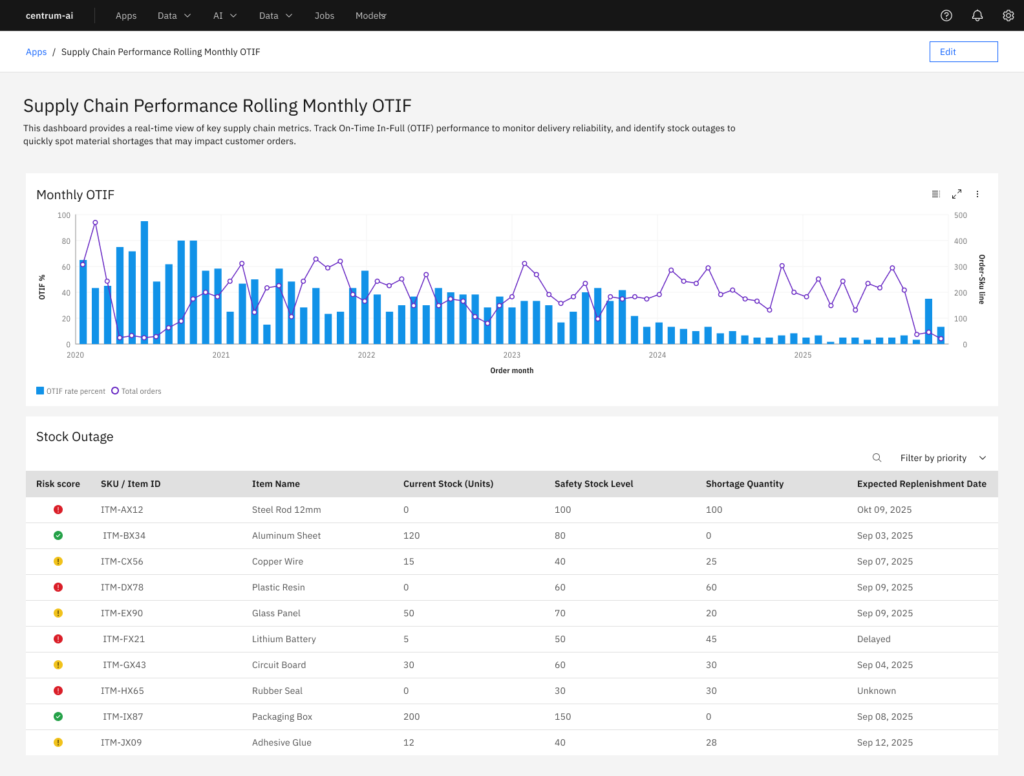
At the same time, central dashboards are available that provide transparency regarding inventories, delivery capacity, production utilization, material availability, and other key metrics. This leads to better decisions based on a common data base. For us, the real added value lies not in the AI itself, but in the intelligent connection of data, processes, and knowledge.
3. Successful digital transformation is a cultural project
Introducing technology is often easier than establishing changes in the workplace. At KOMOS, we have also experienced that new digital tools do not automatically spark enthusiasm. Changes generate questions, uncertainties, and sometimes even skepticism. That is why we recognized early on that digitalization is also always a cultural project. New solutions are only successful if the people who work with them on a daily basis are actively involved. Communication, training, and participation are just as important as the technical implementation. Our experience shows:
It is not the software that determines the success of digitalization – but the people who use it.
4. Connected production processes create competitive advantages
The greatest benefit of Industry 4.0 does not come from individual applications, but from the continuous flow of information along the entire value chain. At KOMOS, development, production, quality assurance, and logistics all use the same data base. Information is available where it is needed. This makes processes more transparent, response times shorter, and decisions more informed. A concrete advantage is evident, for example, in matters of quality or complaints. Relevant information can now be understood much more quickly than in traditional, paper-based processes. The networking of data and processes not only creates efficiency, but also increases the stability and reliability of the entire supply chain. For us, this is exactly the idea behind a smart factory.
5. Artificial intelligence needs a solid foundation
Artificial intelligence is currently one of the most exciting developments in industry. At the same time, we have learned that AI only creates real value when the fundamentals are in place. Clean data, standardized processes, and a networked system landscape are the prerequisites for intelligent applications to operate reliably. Therefore, we do not view AI as the starting point of our digitalization, but as a consistent next step. The actual work begins long before the first AI application is deployed. Anyone who understands their processes, makes meaningful connections between data, and creates transparency lays the foundation for future innovations.
Digitalization is not an objective – but an attitude
The past few years have shown us that digitalization is not a project with a fixed end date. It is a continuous process of development. Companies that want to be successful in the long term must be willing to question processes, take new paths, and actively shape changes. Today, at KOMOS, we benefit from greater transparency, faster decision-making, and significantly stronger networking within our value chain. At the same time, we know that the digital transformation will never be complete. That is why we are continuously working to further develop our processes, to use data more intelligently, and to meaningfully integrate new technologies into our working environment. Because our goal remains unchanged:
Intelligent production processes create the highest quality, maximum delivery reliability and sustainable competitiveness.