

Bringing smart home components safely into series production.
KOMOS develops and manufactures complex smart home assemblies made of mechanics, plastics, electronics, contact connections, and cable assembly. Data and power connections, assembly and testing are coordinated early on – for functional, assembly-ready, and reproducible serial products.
From technical clarification through prototype construction and industrialization to stable mass production, KOMOS takes responsibility for the coordination of the components.
- Start
- Industries
- Smart Home
Smart home systems need more than just electronics.
In smart home products, electronics, mechanics, housings, sensors, contact points, and data and power supply must all work together reliably. If these interfaces are not coordinated until late in the development process, additional development loops, assembly problems, and quality risks arise.
Three key challenges
Many technical interfaces
Electronics, mechanics, sensors, cables, and housings must all work together in a functional and assembly-friendly manner.
High time pressure
Short development cycles require early decisions regarding manufacturability, testing, and the series process.
Stable function in the series
A working prototype is not enough. The assembly must be reproducible for assembly, testing, and documentation.
Integrate data and power safely into the assembly
Smart-home products require reliable power supply, signal transmission, and data communication. KOMOS coordinates contact points, cable routing, plug connections, housing, and assembly early on.
- Clear the power supply and signal paths early
- Configure contact points and plug connections in a reliable manner
- Align cable routing and assembly concept
- Think along from the very beginning with electrical testing
- Assemble and document component assemblies in a reproducible manner
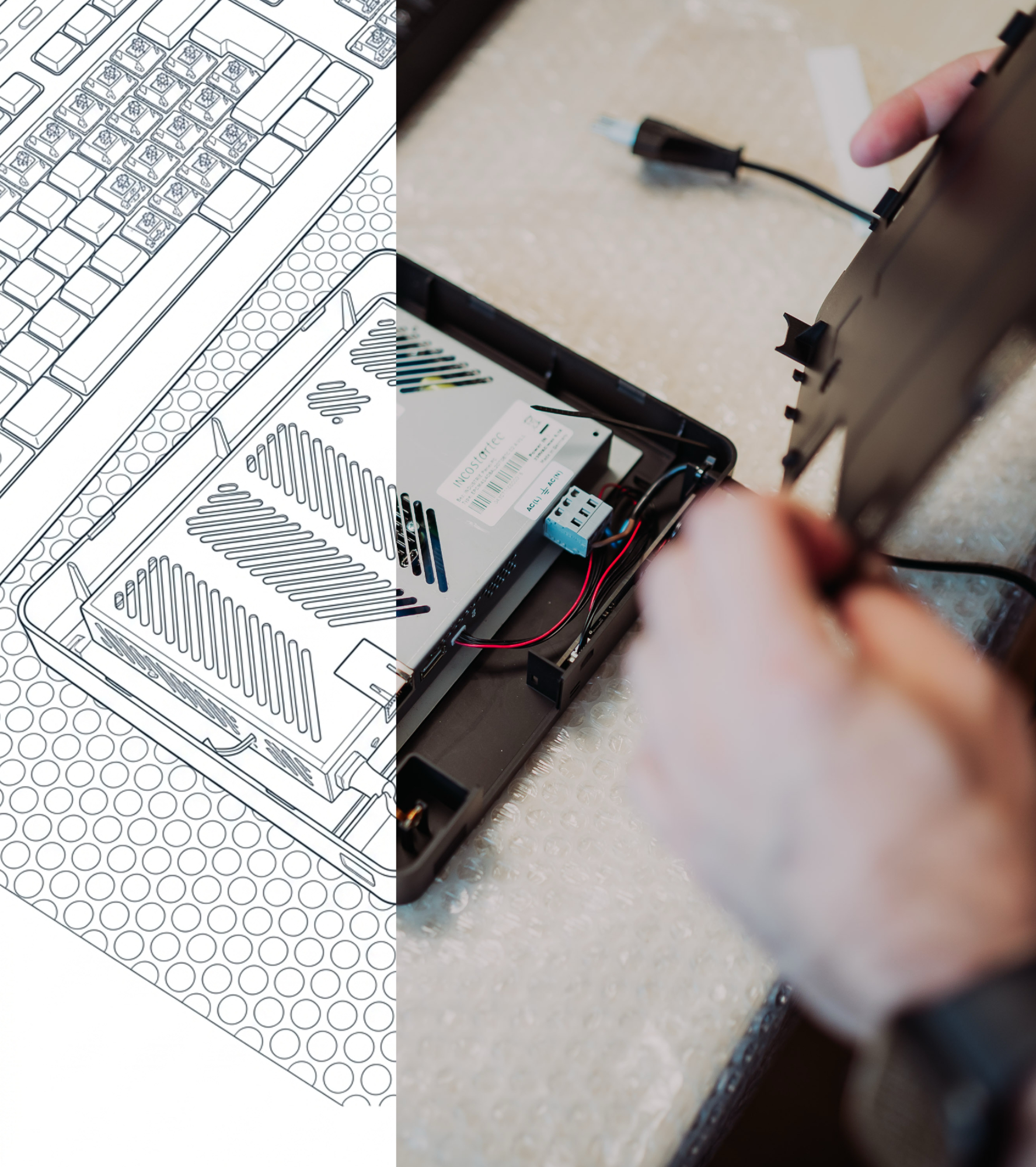
Faster and safer to the Smart Home series

Less technical interfaces
KOMOS combines mechanics, plastics, electronics, cables, contact connections, assembly and testing into a coordinated assembly unit.

Early testing and protection
Test concept, electrical testing and quality requirements are already taken into account during development.

More safety during commissioning
Adjusted processes and defined tests reduce rework, delays, and quality risks.
From the idea to the ready-to-assemble assembly unit
A clear process creates security and speed. Our development process is transparent, documented and designed to identify technical risks at an early stage and keep development times predictable.
Analysis and technical clarification
1 to 2 weeksFunctionality, installation space, interfaces, power supply, data paths, assembly, and quality requirements are all discussed together.
Concept and simulation
3 to 4 weeksThe design concept, material selection, contact arrangement, assembly sequence, and testing strategy are developed.
Model construction and testing
2 to 4 weeksPattern and functional assemblies are manufactured, assembled, tested and technically evaluated.
Industrialization and mass production
6 to 8 weeksProduction processes, tools, testing equipment, documentation and quality planning are being prepared for the series.
Serial production and lifecycle support
KOMOS accompanies changes, variants, product maintenance and the stabilization of the ongoing series.
Frequently asked questions
Can you manufacture vibration-resistant constructions?
Through FEM simulation and corresponding rib reinforcements, we develop housings that can withstand even extreme vibration loads.
Will KOMOS take over the prototype construction and serial production transfer?
Yes. KOMOS accompanies projects from the technical clarification phase through to prototype and functional assemblies and up to industrialization and stable mass production. Production processes, testing equipment, documentation and quality requirements are all prepared step by step for the series.
What manufacturing processes are available for smart home assemblies?
KOMOS combines plastic injection molding, CNC turning, punching and forming technology, cable assembly, component assembly, and electrical testing. Depending on the project, contact bonding, plug connections, housing integration, and documented functional tests are also integrated into the manufacturing process.
How does the KOMOS app support IoT products?
Our KOMOS app automatically documents all software flashings, calibrations
and functional tests. Ideal for IoT certifications and significantly simplifies field update management and documentation.
Which wireless standards can you implement in enclosures?
We develop housings for ZigBee, Z‑Wave, Bluetooth LE, WLAN, Thread and Matter – compliant with EMC standards and optimized for antenna placement.
Does KOMOS support the EMC-compliant design?
KOMOS can take into account constructive and manufacturing requirements for EMC-compliant design, for example regarding housing, cable routing, contact connections, and ground concepts. The specific EMC proofing is carried out project-specifically through appropriate tests and approvals.
How do you document quality and processes?
All process data is recorded digitally, stored in a traceable manner and made available in the customer portal.
Can KOMOS integrate data and power interfaces?
Yes. KOMOS coordinates power supply, signal and data paths, contact connections, cable routing, plug connections, and housing integration. In doing so, assembly and electrical testing are taken into account early on.