
Calculating complexity costs: What does a building block really cost?
21st June 2026
Eight parts, five suppliers, multiple deliveries – and in the end one question: How much does a complete assembly really cost?
There is a pattern that we encounter again and again in manufacturing projects. Not with a single customer, but in many industrial projects: On paper, a component appears economical because each individual part was purchased cheaply. In reality, however, the actual costs often arise between the parts themselves.
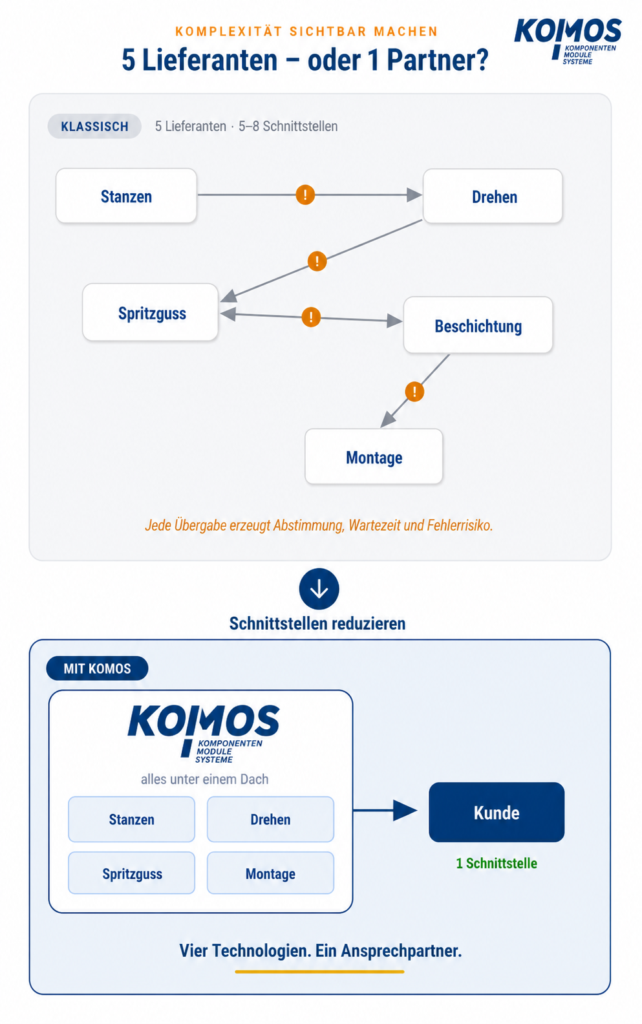
Imagine a component assembly that is typical in medical technology or electronics: about eight individual parts, manufactured and delivered by five different companies. A stamping part from here, a turning part from there, a plastic housing from a third supplier, coating and assembly again somewhere else.
On paper, this is a neat solution. Each part comes from the same supplier, who produces it cheaply and reliably. The purchasing department negotiated five competitive prices.
What is often missing in this calculation is the transfer of responsibility between the parties involved.
Why the part price is not the whole truth
Every interface creates a workload that is not fully visible in any individual part offering: technical coordination, approvals, change loops, waiting times, questions, quality issues, rework, and repeated coordination.
Each individual point initially seems manageable. Together, they create complexity costs – and these arise in a distributed manner: in development, purchasing, quality, assembly, and project management. That is precisely why they are often not fully understood by anyone.
An example that you can calculate yourself
The extent of these distributed costs can be shown by a single factor – without any assumptions about errors or delays, only through ongoing coordination.
Let’s take a project duration of 30 weeks. Who spends 12 hours per week on meetings, emails, and follow-up questions with and between the suppliers, at an internal full-time rate of 90 euros per hour, spends that alone on 32,400 euros. For coordination only. This amount does not appear in any of the five parts of the offer.
And that’s just one factor. Release and change loops, waiting times between suppliers, assembly and testing costs, and complaints at the delivery points are added on top of that. Each of these items in isolation is unremarkable. Taken together, they significantly shift the true price of a component – up, but invisible.
The crucial leverage: reducing interfaces
The decisive leverage is not always negotiating each part individually. Often the greater effect lies in reducing the number of interfaces. This is where KOMOS comes in.
Stamping, turning, injection molding, and assembly all take place under one roof at KOMOS. From five to eight suppliers and several transfers can become one partner with a clear interface. Coordination chains are shortened. Release loops are handled internally rather than between multiple companies. Many sources of error at transfer points are reduced because development, production, and assembly all take place in a single system.
The remarkable thing is that the part price hardly changes at all. What does change is everything that wasn’t clearly stated in the invoice before.
Calculate the complexity costs yourself
The 32,400 euros From the example, only the voting was included. How high the total distributed effort in one of your projects is, when loops, waiting times, assembly, testing, and quality issues are added, depends on your own numbers.
That’s exactly what you can enter. Our complexity cost calculator takes into account the factors that arise around the part price:
-
- Coordination between suppliers
-
- Release and change loops
-
- Waiting times and delays
-
- Complaints and rework
-
- Assembly and testing effort
-
- Internal coordination
You input your own values and in just a few minutes you get an initial estimate – not as a substitute for a technical discussion, but as a starting point for the right question:
Where is your assembly becoming more expensive today due to complexity than it should be?
Anyone who wants to save on production costs should therefore not only look at the part price, but also at the complexity costs associated with the entire assembly unit.
→ Use the complexity cost calculator now: komos.de/produktionskosten-einsparen