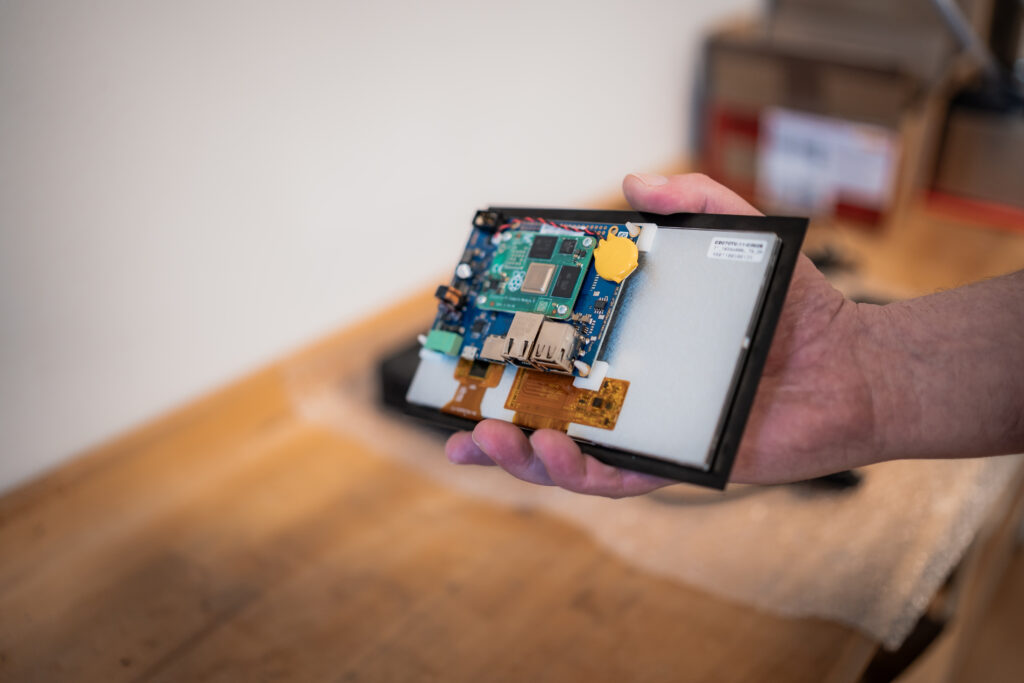
From prototype to series production: Industrialization of electromechanical assemblies
22nd October 2026
From prototype to series production: Industrialization of electromechanical assemblies
A working prototype is not yet a commercially viable product.
From the prototype to the series production, it is often a long way from the initial idea to the finished product. KOMOS GmbH from Bürgel (Thuringia) supports manufacturers from the production-ready rework through tools and sampling to the approved series – with its own metal and plastic manufacturing, assembly and testing, in series sizes from 100 to 50,000 units.
A prototype shows that a technical idea can in principle work. Whether it can be developed into an economically viable mass-produced product, however, is often determined only at the next step.
Material selection, tolerances, tool concepts, assembly processes and testability must be adapted to later series production. Especially with electromechanical functional assemblies, special challenges arise.
Different technologies must work together
When metal parts, plastic components, contacts, cables, or sensors all perform a function together, the individual manufacturing steps influence each other.
A constructive change to a component can have an impact on tools (Have parts punched and bent made: Why processing determines the final result – KOMOS), There are assembly processes or testing requirements. Therefore, it makes sense to take the later manufacturing into account during development.
What often doesn’t matter much in the prototype becomes crucial in the series:
- 3D-printed or milled parts are replaced by injection molding and stamping tools with their own design rules.
- From hand assembly by developers, it becomes a reproducible assembly by trained employees.
- From the experimentation, defined test characteristics and limits will be derived.
- Catalog parts that are sufficient in small quantities in the sample must be available in series quantities.
The journey from prototype to series production
Industrialization involves several interconnected tasks:
- Examination of the design for manufacturability
- Selection of suitable manufacturing processes
- Selection of materials and tolerances
- Planning of tools and assembly processes
- Determination of test characteristics
- Sampling and release
- Establishing a stable serial production process
The earlier these aspects are considered along the path from prototype to series, the greater the chances of avoiding subsequent changes. Ideally, this should be done before tools are ordered, because then changes are still affordable.
From the component to the functional assembly
KOMOS supports the industrialization of technical components and assemblies by combining its own manufacturing processes and integration expertise.
The focus is on translating technical requirements into reliable, economically viable series processes.
With this, KOMOS is particularly suitable for manufacturers who not only require individual parts but also want to have complete functionality built externally into their product. (What does supplier complexity really cost you? – KOMOS) This also applies to technology start-ups and spin-offs that are looking for a partner with experience in serial production without having to start large-scale production immediately.
Are you developing a new technical product?
Whether existing design, initial prototypes or preparation for mass production: KOMOS helps you turn different components into a reliable functional assembly unit that can be manufactured.
Talk to us early about the industrialization of your assembly line.