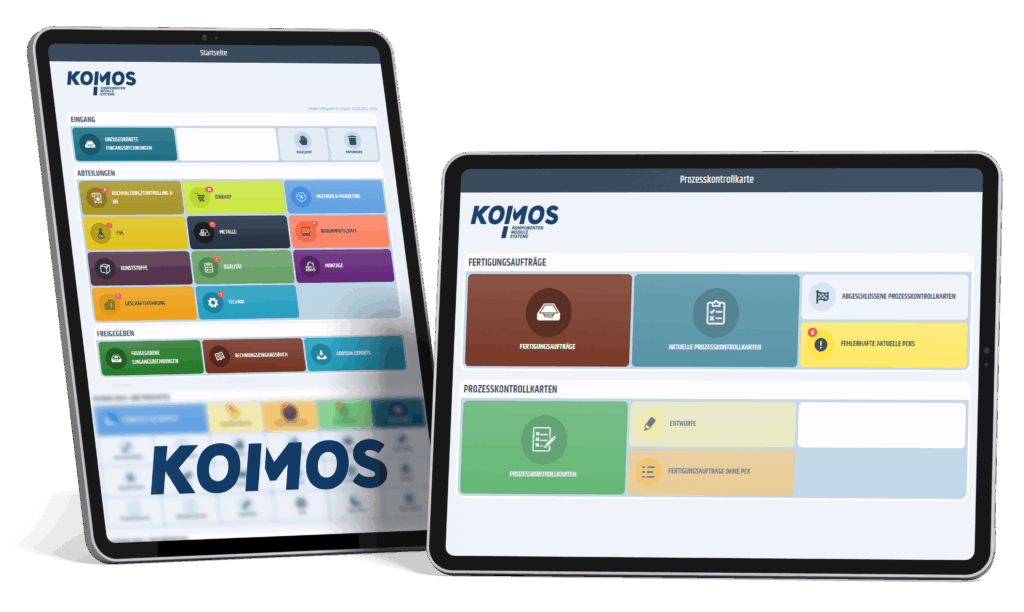
Why we developed our own app
February 4, 2026
In 2020, we faced a fundamental decision at KOMOS:
Should we buy an established MES system – or take a different path?
The standard solutions available on the market were primarily designed for large corporations: extensive, complex, structurally rigid, and associated with investments that were out of proportion to the requirements of a family-run company with around 75 employees.
Instead of adapting our processes to a system that doesn’t suit us, we deliberately chose a different approach. We took a close look at the requirements: What exactly do we really need? What functions do our existing software tools already provide? And where do we encounter media gaps, duplication of work, or unnecessary complexity?
It quickly became clear that our existing ERP system already forms a stable and reliable foundation for our processes. Instead of replacing it, we have decided to consistently continue using it and specifically expand it. Not through another isolated system, but through a proprietary application that targets exactly where standard solutions reach their limits.
Based on these considerations, the KOMOS app It has been created. It complements our ERP system meaningfully, connects existing data sources, and makes information available where it is needed. Today, we use it to control all manufacturing and administrative processes – from order planning to production and delivery.
The app was developed together with our employees and is continuously being developed. This way, a digital solution is created step by step that was not created from scratch but grew out of practical experience – tailored exactly to KOMOS.
What our customers get out of it
The consistent digitalization of our processes is not an end in itself. It creates concrete benefits for our customers:
- More planning certainty
Thanks to continuous digital processes, we always know the current status of an order and can guarantee realistic, reliable delivery dates. - High transparency
Information from planning, production, and logistics is interconnected. This allows us to make clear statements about the progress of production and to streamline coordination. - Quick reaction ability
Changes in quantities, deadlines, or priorities can be evaluated and implemented in a short time – without media disruptions or information losses. - Reliable quality and adherence to deadlines
Clear processes, up-to-date data, and unambiguous responsibilities increase process reliability and ensure stable, reproducible results.